
Writing
Vocabulary, Grammar And Punctutation Progression Map
INTENT
At Southwold, we believe that English, including reading and writing, is at the heart of our learning and teaching and essential to every area of the curriculum. It is through English that concepts are formed and we are able to make sense of the world and our place within it. We value the importance of speaking with confidence, fluency and clarity, creating a reading culture where children and adults are able to read for pleasure and understanding, and writing with fluency, stamina and for a range of different genres. Effective writing includes the ability to generate ideas, form letters, spell words and construct sentences, paragraphs and whole texts. We aspire for all pupils to be able to write fluently and as a form of personal expression.
Overall, we aim to:
- Develop spoken language based on individual need and for a range of purposes; to ensure that our children are confident taking part in conversations within wider society, as well as in school.
- Adopt a love of reading and respect of books and the power of words.
- Develop children’s domain level and text level knowledge, especially when working towards a big write.
- Deliver a variety of opportunities for writing based on quality core texts that offer a mastery approach to understanding vocabulary, genre and grammar.
- Provide regular practise of foundational skills to support automaticity.
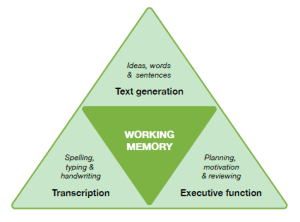
- Explicitly teach the three main components of writing; transcription, composition and executive function.
- Provide children with cross curricular links so their writing is purposeful.
- Ensure all children are supported in meeting the Early Learning Goals in the Early Years Foundation stage and End of Year Expectations outcomes.
- Assess children’s progress both formatively and summative to ensure they are making the best progress possible and any misconceptions are promptly addressed.
- Plan lessons that are accessible for all children, whilst remaining engaging and exciting.
- Sequence learning to provide opportunities for planning, revising, editing and publishing written work.
IMPLEMENTATION
We follow the National Curriculum (NC) 2014 to deliver lessons rich in reading, writing, phonics, spelling, grammar and punctuation through our whole school English curriculum, where high-quality texts are used to deliver all aspects of the curriculum. Each book is carefully chosen to match the NC reading and writing requirements for each year group. Where possible, English will link to the class topic to ensure learning is meaningful, purposeful and contextual; making links between writing style and vocabulary. Where English does not link to the foundation curriculum topics, year groups work on carefully chosen, high-quality texts, which provide children with an understanding of the wider world. This approach provides the children with a deeper understanding of texts. We think it is important for our children to value the importance of reading to develop and enhance writing and to see a clear purpose and context for writing.
Early writing is taught through early mark making, then when the children begin Read Write Inc. Phonics, they are taught the correct letter formations. This begins with writing CVC words, moving onto short sentences using the sounds they have been taught. EYFS children are encouraged to write independently during continuous provision.
From Year 1 – Year 6, the English curriculum is taught by studying the high-quality texts from The Reading Spine, from which various writing opportunities are then derived. To support our English planning and structure of teaching, we use ‘The Teaching Sequence for Writing’. It is research informed and practically applies evidence into effective best bets for improving writing outcomes. The Teaching Sequence for Writing considers the Beringer et al. (2002). ‘Simple View of Writing’ referenced in the Education Endowment Foundation’s (EEF) Improving Literacy in KS2 guidance. Where children are not transcriptionally fluent, adaptations should be made to support them to focus on composition or transcription in isolation to reduce cognitive load. Executive function should also be explicitly modelled. A quality of practise that benefits all pupils, especially when introducing new learning.
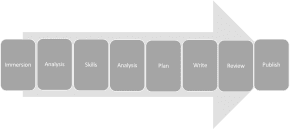
The sequence is based on a 3-4 week unit, following the sequence below.
We aim to provide our pupils with a ‘language rich’ environment and within our classrooms, we explore ambitious vocabulary using in all lessons and use our working walls to acquire an understanding of new and unknown words. We use the Read Write Inc. Spelling scheme for children in Y2-6 who no longer need Read Write Inc. Phonics.
The Teaching Sequence for Writing provides children with the opportunity to see teachers modelling high quality writing with accurate spellings, grammar and handwriting. Demonstration writing and shared editing (where teacher and class edit and improve a piece of work together) supports all children as they develop their independence throughout their school years.
IMPACT
At Southwold, our children will enjoy writing and view themselves as effective, competent writers; they will have a good understanding of the purpose of writing and can write effectively for a range of purposes and audiences. By the time they reach the end of KS2, every child will be a confident, accomplished writer. Pupils will have a wide vocabulary that they use within their writing. Pupils will leave primary school being able to effectively apply spelling rules and patterns they have been taught.
The quality of reading and writing in English is evaluated by learning walks, drop-ins, ‘pupil voice’ discussions and book looks. This informs the subject leader of the impact of new initiatives as well as future areas for improvement. After monitoring, the subject leader provides feedback to SLT and individuals/whole staff to address areas for development.